
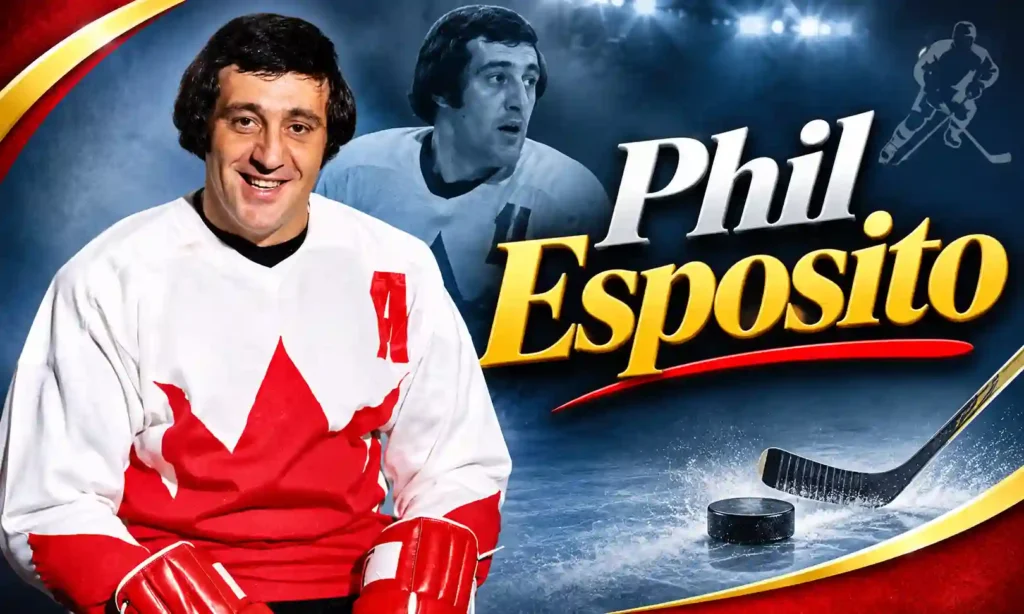
Phil Esposito retired in 1981. By then he had scored more goals than anyone in National Hockey League history except Gordie Howe, and more points than anyone except Gordie Howe. Forty-five years later, he sits seventh in goals and twelfth in points.
That is less a demotion than a measure of how long ago he did it. He was the first player to score 100 points in a season, the first to score fifty goals five years running, and for six straight seasons nobody in the sport scored more than he did. He also offered a televised speech one night in Vancouver that Canadians of a certain age can still recite. Here is the whole of it, including where his numbers actually stand today rather than where they stood when he stopped.
Physical Stats
The basics first, because his size was central to the way he scored.
| What people ask | Answer |
|---|---|
| How tall is Phil Esposito? | 6 ft 1 in (185 cm). |
| What did he weigh? | He is usually listed at 205 lb (93 kg), although some sources put him closer to 215 lb. |
| Did his build matter? | Yes. He was big for a centre of his era and built his scoring style around standing in front of the net and refusing to be moved. |
| What position did he play? | Centre. He shot left. |
| What number did he wear? | No. 7 in Boston, which the Bruins retired, and No. 77 with the Rangers. |
| When was he born? | 20 February 1942, in Sault Ste. Marie, Ontario. |
| How old is he? | 84 years old. |
| Which teams did he play for? | Chicago, Boston, and the New York Rangers. |
| Was his brother a player too? | Yes. His brother, Tony Esposito, was a Hall of Fame goaltender who died in 2021. |
| Is he in the Hall of Fame? | Yes. He was inducted in 1984. |
| What does he do now? | He works as a radio colour commentator for the Tampa Bay Lightning, the club he helped bring into existence. |
At six foot one and about 205 pounds, he was a big centre for the 1960s and ’70s. Quick? No, and he never claimed otherwise. His game was to park himself right in front of the goalie, absorb whatever punishment came with it, and bury the rebounds and deflections nobody else could get near. A whole lot of his 717 goals came from inside about ten feet.
The Trade
Chicago had him for four seasons, mostly as a support player, and often on a line with Bobby Hull. He was good, sure, but not remarkable yet, and his best year there topped out at 61 points.
Then in May 1967 Chicago shipped him to Boston with Ken Hodge and Fred Stanfield. People still call it one of the most one-sided trades ever. His first season with the Bruins he jumped to 84 points. His second, he scored 126. Nobody in league history had ever hit 100.
The Boston Years
What came next was a six-season run that almost nobody has matched. He led the league in goals every year from 1969-70 through 1974-75, won the scoring title five times (four of those in a row), and was named MVP twice.
The 1970-71 season is the one people always bring up. He put up 76 goals and 152 points, and that goal total stayed the single-season record until Wayne Gretzky scored 92 in 1981-82. That was also the year he became the first player to hit fifty or more in five straight seasons, a streak that ran through 1974-75.
Boston took the Stanley Cup in 1970 and again in 1972. Then in November 1975 the Bruins traded him to the New York Rangers, and Boston reacted about the way you’d expect people to react to a death in the family. He captained the Rangers for three years, got them to a Stanley Cup Final in 1979, and retired in 1981 at 39.
| Season | Team | Games | Goals | Assists | Points | What Was Happening |
|---|---|---|---|---|---|---|
| 1963–64 | Chicago | 27 | 3 | 2 | 5 | A handful of games as a 21-year-old. |
| 1964–65 | Chicago | 70 | 23 | 32 | 55 | A full season, often on Bobby Hull’s line. |
| 1965–66 | Chicago | 69 | 27 | 26 | 53 | Productive, but not yet a star. |
| 1966–67 | Chicago | 69 | 21 | 40 | 61 | His last season before the trade that changed his life. |
| 1967–68 | Boston | 74 | 35 | 49 | 84 | An immediate jump in his first year with the Bruins. |
| 1968–69 | Boston | 74 | 49 | 77 | 126 | The first 100-point season anyone had managed. |
| 1969–70 | Boston | 76 | 43 | 56 | 99 | One point short of a hundred, and a Stanley Cup. |
| 1970–71 | Boston | 78 | 76 | 76 | 152 | Seventy-six goals, which stood as the single-season record until 1982. |
| 1971–72 | Boston | 76 | 66 | 67 | 133 | A second Stanley Cup. |
| 1972–73 | Boston | 78 | 55 | 75 | 130 | His third scoring title in a row, and his fourth overall. |
| 1973–74 | Boston | 78 | 68 | 77 | 145 | Sixty-eight goals and a second Most Valuable Player award. |
| 1974–75 | Boston | 79 | 61 | 66 | 127 | The fifth straight season he scored at least fifty goals. |
| 1975–76 | Boston and NY Rangers | 74 | 35 | 48 | 83 | Traded to the Rangers in November, to disbelief in Boston. |
| 1976–77 | NY Rangers | 80 | 34 | 46 | 80 | Captaining a club in transition. |
| 1977–78 | NY Rangers | 79 | 38 | 43 | 81 | Still scoring at nearly forty goals a season at age 36. |
| 1978–79 | NY Rangers | 80 | 42 | 36 | 78 | Forty-two goals at 37, and a run to the Stanley Cup Final. |
| 1979–80 | NY Rangers | 80 | 34 | 44 | 78 | His last full season. |
| 1980–81 | NY Rangers | 41 | 7 | 13 | 20 | Forty-one games, then retirement. |
| Career | — | 1,282 | 717 | 873 | 1,590 | Eighteen seasons and 137 points in 130 playoff games. |
Where His Numbers Stand Now
Most pages about him still quote the rankings he held on the day he retired. Those were accurate in 1981 and are not accurate now, and the honest version is more interesting anyway.
| Career Figure | Number | Rank Now | How That Has Changed |
|---|---|---|---|
| Goals | 717 | 7th | He retired second behind Gordie Howe. Six players have since passed him. |
| Points | 1,590 | 12th | He retired second, but eleven players are now ahead of him. |
| Assists | 873 | Outside the Top 10 | Assist totals have risen sharply since his era. |
| Games Played | 1,282 | Outside the Top 50 | Careers generally last longer now than they did in the 1970s. |
| Goals in One Season | 76 | 2nd | Wayne Gretzky scored 92 in 1981–82 and later recorded 87. |
| Points in One Season | 152 | Outside the Top 10 | Gretzky and Mario Lemieux both surpassed this total repeatedly. |
The one worth dwelling on is the single-season goal record. Only Gretzky has scored more in a season than Esposito’s 76, and that has now been true for more than four decades.
The Trophy Case
Laid out with the years attached.
| Honour | Years | What It Is For |
|---|---|---|
| Art Ross Trophy | 1969, 1971, 1972, 1973, 1974 | Awarded to the league’s leading scorer. Esposito won it five times, including four consecutive seasons. |
| Hart Trophy | 1969 and 1974 | Recognised as the league’s Most Valuable Player, as voted by sportswriters. |
| Lester B. Pearson Award | 1971 and 1974 | Awarded to the most outstanding player, as voted by fellow players. |
| Stanley Cup | 1970 and 1972 | Won both championships with the Boston Bruins. |
| League Goalscoring Leader | 1970 to 1975 | Finished as the league’s leading goal scorer for six consecutive seasons. |
| Lou Marsh Trophy | 1972 | Named Canada’s Athlete of the Year following the Summit Series. |
| Canada Cup | 1976 | Won gold with Team Canada. |
| Lester Patrick Trophy | 1978 | Recognised for outstanding service to hockey in the United States. |
| Hockey Hall of Fame | 1984 | Inducted into the Hockey Hall of Fame. His brother Tony followed in 1988. |
Vancouver, September 1972
Canada pulled together its best players to face the Soviet Union in an eight-game series in 1972, fully expecting to win without much trouble. They didn’t. By game four in Vancouver, Canada was behind in the series, and after losing 5-3 that night, the home crowd booed them off their own ice.
Johnny Esaw interviewed Esposito on camera right after the game. Still in his gear and out of breath, he said the players were disheartened and disillusioned, that they’d given everything they had, that they were there out of love for their country and not for money, and that getting booed in their own buildings was hard to take. He offered an apology to any fan who’d booed them, though he figured he wouldn’t get one back.
It became the defining image of that game, and maybe of the whole series. Esposito has said he didn’t watch the footage himself until 1982.
From there Canada went to Sweden for a couple of exhibition games before heading to Moscow, and Esposito has pointed to that week as when the group turned into a real team. They took the series four games to three with one tie. Esposito ended up the leading scorer with 13 points, put up more shots than anyone else in the tournament at 52, had the only four-point game of any player, and set up Paul Henderson’s winner in the last minute of the final game.
Net Worth and Career Earnings
His playing income looks wild by today’s standards. Across eighteen seasons of published NHL salaries, he pulled in a career total of 5,108,662 dollars, which comes out to roughly 21.4 million in today’s money. His best-paid season brought him 400,000 dollars, and even that number is disputed. Some reports from the time put it somewhere between 250,000 and 300,000.
Put that career total next to a leading forward’s pay today and it’s less than one season. And he still scored more goals than all but six players who have ever laced up.
His net worth is a different story, and a private one. Over the decades since, he’s earned from executive roles, from founding and running a franchise, and from broadcasting. None of that is disclosed. Any site that publishes a precise net worth figure for him is guessing. The salary total above is the part you can actually check.
Building a Team From Nothing
He spent 1986 to 1989 as general manager and head coach of the Rangers. What he did next was a lot less ordinary.
He and his brother Tony wanted an NHL team in Florida, a state with no hockey tradition and nowhere to put a rink. The league granted the expansion bid in December 1990, and the Tampa Bay Lightning hit the ice in 1992-93. Esposito was the club’s first president and general manager, and he stayed in that job until 1998.
The franchise he talked into being has won a Stanley Cup since, and its own hall of fame has his name in it. He’s still on the radio calling their games.
Where to Find Him Online
We checked each platform. He is present but not prolific.
| Platform | Where to Find Him | What We Found When We Checked |
|---|---|---|
| X (formerly Twitter) | @PhilEspo7 | An account under his name using his retired Boston jersey number. This suggests it may be his account, although no independent media confirmation was found. |
| philespo7 | A page using the same handle and number as his X account. | |
| Nothing confirmed | No account could be verified as his official profile. | |
| YouTube | No personal channel | His goals, Summit Series footage, and broadcasting work are available through league, club, and broadcaster channels. |
| Nothing found | No public professional profile was identified. His club role is listed on the Tampa Bay Lightning website instead. |
Questions People Ask
How old is Phil Esposito?
He is 84, born on 20 February 1942 in Sault Ste. Marie, Ontario.
How tall is Phil Esposito?
6 ft 1 in, or 185 cm, and he played at around 205 lb.
What are Phil Esposito’s career stats?
1,282 games, 717 goals, 873 assists and 1,590 points, plus 137 points in 130 playoff games.
Was he the first player to score 100 points?
Yes. He scored 126 in 1968-69, the first time any player had reached three figures.
How many goals did he score in 1970-71?
Seventy-six, along with 152 points. It was the single-season record until Wayne Gretzky scored 92 in 1981-82.
Where does he rank on the all-time lists now?
Seventh in goals and twelfth in points. He was second in both when he retired.
How many Stanley Cups did he win?
Two, with Boston in 1970 and 1972.
What did he do in the 1972 Summit Series?
He led all scorers with 13 points and assisted on the winning goal. His televised remarks after the loss in Vancouver became one of the best-known moments in Canadian sport.
Did Phil Esposito found the Tampa Bay Lightning?
He co-founded it with his brother Tony. The bid was granted in 1990 and he served as the club’s first president and general manager.
Who was Tony Esposito?
His younger brother, a Hall of Fame goaltender who won three Vezina Trophies. He died in 2021.
Also read about: Miikka Kiprusoff: The Fifth-Round Backup Who Set a Record Nobody Had Touched in Sixty Years

