
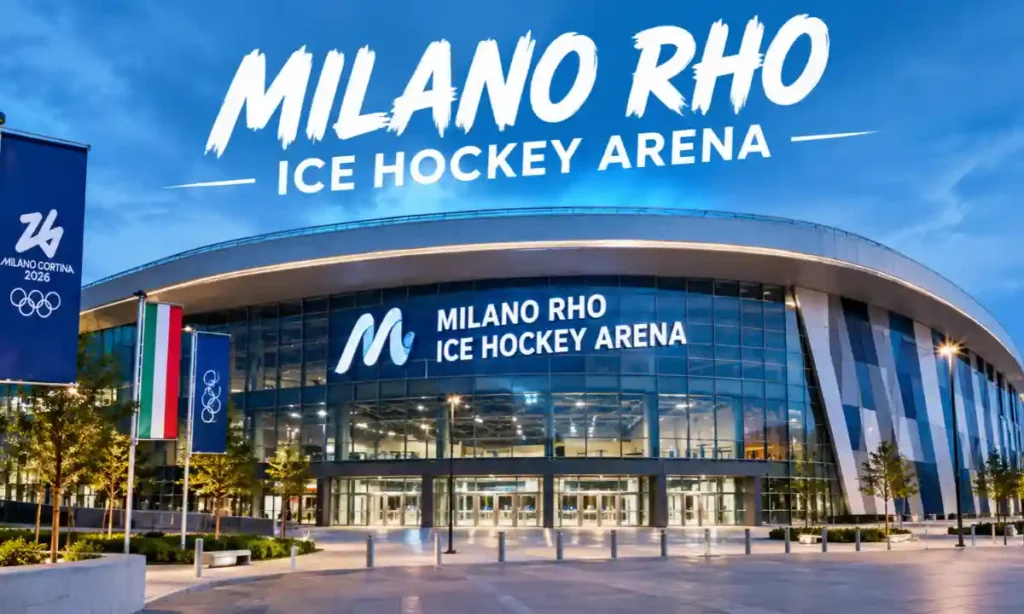
The Milano Rho Ice Hockey Arena hosted the other hockey competition at the 2026 Winter Olympics, and it has now been removed. It wasn’t meant to be. It was a temporary arena housed in a pavilion of the Fiera Milano exhibition centre, and it was dismantled immediately after the conclusion of the Games in February 2026.
It had been filling up to around 6,500 people for about three weeks, enabling the men’s, preliminary, games, and most of the women’s tournament to take place before the pavilion was returned to its original task of trade show exhibition. This is what it was, why it even happened at all, and where to go instead if you want to watch hockey in Milan.
The Arena at a Glance:
Checked October 2026.
| Detail | |
|---|---|
| What it was | The secondary ice hockey venue of the 2026 Winter Olympics in Milan |
| Does it still exist? | No. It was a temporary build and was never intended to survive the Games |
| Where it stood | Inside the Fiera Milano exhibition centre, on the boundary between Rho and Pero, northwest of Milan |
| Part of | Milano Ice Park, which occupied four pavilions of the trade fair complex |
| Capacity | Usually given as 6,500, though published figures range from about 5,700 to 6,500 |
| The building it sat in | Fiera Milano, opened in 2005 and designed by the architect Massimiliano Fuksas |
| What it hosted | Men’s preliminary round games and much of the women’s tournament |
| What it did not host | The medal games. Those were at Milano Santagiulia |
| Olympic dates | The hockey tournaments ran from 5 to 22 February 2026 |
| Why it was built | Two other venue plans collapsed over cost. This was the fallback |
| Can you visit it? | Not as an arena. The pavilions have returned to exhibition use |
| Checked | October 2026 |
Why It Existed: A Chain of Collapsed Plans:
This venue was not in the original Olympic bid. It is the end result of two separate projects falling over for the same reason.
How Milan ended up playing Olympic hockey in a trade fair hall.
| Stage | What happened |
|---|---|
| Original plan | PalaSharp, a 10,000-seat arena in Milan and the former home of the Olimpia Milano basketball club, was to be renovated and renamed Milan Hockey Arena |
| The problem | PalaSharp had been abandoned in 2011 in a state of total degradation, and renovation costs rose beyond what organisers would accept |
| Second casualty | Separately, plans to renovate the speed skating oval at Baselga di Pine were halted in April of the same year, also over cost |
| The fallback | Both sports were moved into the Fiera Milano exhibition complex, which became Milano Ice Park |
| What that meant | A trade fair pavilion was fitted with an international-standard ice rink and temporary seating, and the speed skating track went into a pavilion opposite |
| The upside | No new permanent building was constructed for a use that would not have survived the Games |
PalaSharp is the building in question. A 10, 000 seat arena that had previously played home to the Olimpia Milano basketball team was deserted in 2011, said to be in a ‘state of total decay’. Originally intended to be redeveloped with a new name, Milan Hockey Arena. Though, when they couldn’t come to terms on a budget, they had to find somewhere else within a matter of weeks.
Almost simultaneously, development of the proposed renovation of the speed skating oval at Baselga di Pine was also stopped due to lack of funding. Two sports had suddenly lost their designated sites.
The only solution was Milano Ice Park: four of the pavilions of the complex Fiera milano were turned into temporary sport arenas, with the hockey rink in one and the speed skating in a pavilion right opposite. It was not envisaged, but it was a doing success.
The Building It Sat Inside:
Fiera Milano is one of the biggest exhibition complexes in Europe. It was built in 2005 and was designed by the Italian architect Massimiliano Fuksas. It is situated on the border line between the towns of Rho and Pero, which are situated northwest from the center of Milan where the arena takes the name from.
Constructions of an Olympic ice rink within a trade fair hall is always more complex than a mere ice pad. The pavilion required a refrigerated pad based on international quality, temporary stands and the entire slew of broadcasting trucks, team support and stadium movement. Virtually all elements in the final arena are temporary, except the permanent sanitary blocks.
What It Was Like
Spectators’ reports were a bit inconsistent, but precisely the sort of thing one should be honest about recording.
The seating was definitely not uncomfortable more comfortable than at the larger Santagiulia arena and the signage for rows/seat numbers was very easy to read. The atmosphere was charged as the space had been squeezed to the max; it was packed and loud.
The disadvantages were structuralliterally. The support pillars for the pavilion meant certain seats had limited sightlines to the ice, a compromise related to repurposing a building for a new function. Capacity was almost universally considered to be inadequate for hockey at the Olympics.
The Two Milan Hockey Venues Compared:
If you are trying to work out which arena you saw a particular game in, this is the distinction that matters.
The secondary venue against the main one.
| Milano Rho | Milano Santagiulia | |
|---|---|---|
| Status | Temporary. Built for the Games and removed afterwards | Permanent. Built as a legacy venue for the city |
| Capacity | Around 6,500 | Reported between 10,000 and 16,000 depending on the source and configuration |
| Location | Fiera Milano, between Rho and Pero, northwest of the city | Santa Giulia district, southeast Milan |
| The building | An exhibition pavilion converted with temporary stands and an ice pad | A purpose-built arena designed by David Chipperfield |
| Hosted | Men’s preliminaries and much of the women’s tournament | Preliminaries, the semi-finals and both gold medal games |
| Afterwards | Dismantled. The pavilions returned to trade fair use | Continues as a concert and events arena, known as PalaItalia |
The main difference is permanence. Santagiulia (aka PalaItalia) was built deliberately by private investors as a lasting venue for the city, by David Chipperfield, and is still used for concerts and events. Rho was always a three-week building.
A comment about capacity figures. The published figures for Rho and Santagiulia are quite different based on the source. Rho can be stated as anything between c. 5,700 and 6 500 Santagiulia 10,000 to 16,000 according to whether the figure includes only spectators who have paid money to be there, and, which type of stands etc. the figure is referring to. Since there is no agreement on this I decided to give the range.
What Happened There:
Rho hosted group stage hockey in both tournaments, and the bulk of the women’s schedule. The medal games were at Santagiulia.
The 2026 Olympic hockey tournaments.
| Result | Detail | |
|---|---|---|
| Men’s gold | United States | Beat Canada 2-1 in overtime on 22 February, at Santagiulia. Jack Hughes scored the winner |
| Women’s gold | United States | Their third Olympic title. Canada took silver |
| Women’s bronze | Switzerland | Sweden finished fourth |
| Women’s tournament | 10 teams | Ran from 5 to 19 February across both Milan venues |
| Rho’s role | Preliminaries | Group stage games in both tournaments, and the bulk of the women’s schedule |
| Test event | Italy against Estonia | Played at Rho before the Games to commission the venue |
Both gold medals to the United States; both games were decided by victory over Canada in the final. The men’s gold medal match, won in overtime by Jack Hughes on the 46th anniversary of the Miracle on Ice, was played at Santagiulia rather than here.
Before the Games, Rho was hired with a test event involving Italy and Estonia, which represents the usual method of ensuring ice lights broadcast and crowd systems are functioning before they become mattering.
Can You Still Go?
Not for this arena. After the Games, the ice pad, the viewing stands and all equipment were taken away, and the pavilion reverted to sitting as a trade fair and exhibition center. Fiera Milano is still a leading venue for such events in one of Europe’s key trading cities, and is open to the public, but the rink has gone.
If you intend to watch ice hockey or if you are keen on witnessing some of the most important moments in the history of the Italian capital of fashion, then the only Olympic legacy that will endure is the one that lies underground in the Santa Giulia quarter of southeast Milan, where the remaining empty shell of the Milano Santa Giulia used to be, has become PalaItalia. That piece of architecture was built to last for a longer period of time than the 4 years of the Games, and is the real Olympic legacy left in and for the Italian economic metropolis.
Final Take:
Milano Rho Ice Hockey Arena was able to last for around three weeks, within a trade fair hall due to two other venue proposals collapsing because of issues with cost. It accommodated approximately 6,500 spectators and had columns in inconvenient locations. It no longer exists.
Compared to that, which is problematic in its own right, it’s a success. Milan didn’t go ahead with an unnecessary all year round venue in an under populated area but used an existing hall and a new venue that would be handy in the time to come. More host cities should be that pragmatic.
Frequently Asked Questions:
What was the Milano Rho Ice Hockey Arena?
The secondary ice hockey venue of the 2026 Winter Olympics, a temporary arena built inside a pavilion of the Fiera Milano exhibition centre, northwest of Milan.
Does the Milano Rho Ice Hockey Arena still exist?
No. It was a temporary structure and was removed after the Games. The pavilion has returned to exhibition use.
What was its capacity?
Usually given as 6,500, though published figures range from about 5,700 to 6,500 depending on the source.
Which games were played at Milano Rho?
Men’s preliminary round games and most of the women’s tournament. The semi-finals and both gold medal games were at Milano Santagiulia.
Why was it built in a trade fair hall?
Because two earlier plans failed on cost. The renovation of the PalaSharp arena was abandoned, and separately the speed skating oval at Baselga di Pine was dropped. Both sports were moved into Fiera Milano pavilions.
What is the difference between Milano Rho and Milano Santagiulia?
Rho was temporary, held around 6,500 and hosted preliminaries. Santagiulia is a permanent purpose-built arena, considerably larger, and hosted the medal games. Santagiulia still operates, as PalaItalia.
Where exactly was it?
Inside the Fiera Milano exhibition complex, on the boundary between the towns of Rho and Pero, northwest of central Milan. The complex opened in 2005 and was designed by Massimiliano Fuksas.
Who won the hockey at the 2026 Olympics?
The United States won both the men’s and women’s tournaments, beating Canada in both finals. Both gold medal games were played at Milano Santagiulia.
Also read about: Where Did Ice Hockey Originate? Two Questions People Keep Confusing

