
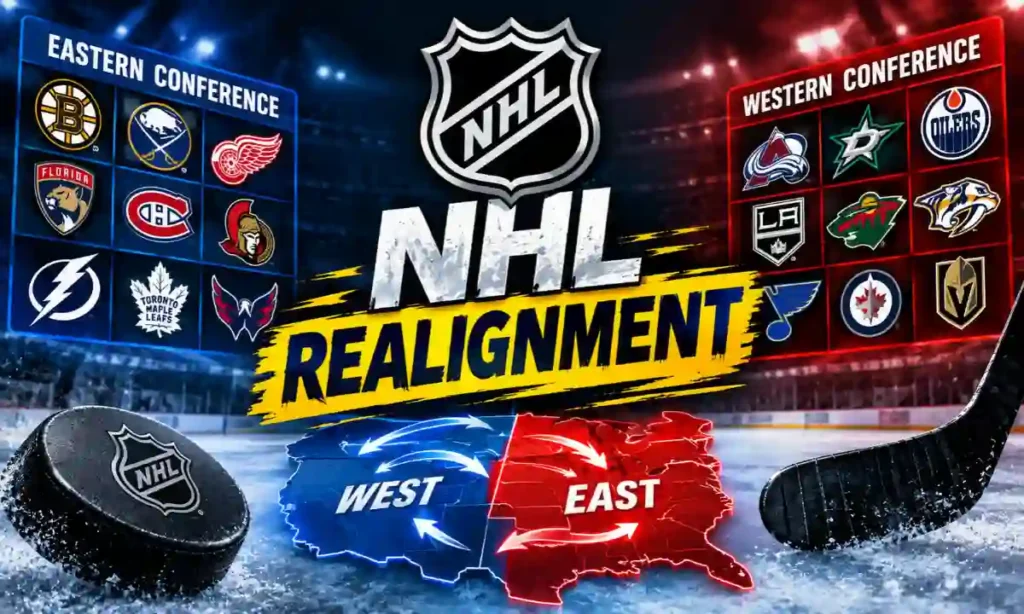
The NHL is not realigning. The 2 conferences with 4 divisions of 8 teams apiece is the current format and has been since 2013-14 as no plan to change it has been passed or announced. What has altered is the demand for it. The expansion debate has become heated; Houston Atlanta numerous other cities being considered and an expansion fee of around $2 billion being quoted. Accommodating only one new franchise would ruin the existing calculations of the league’s present configuration; this way the constant wonder of realignment. Here is the reality, the complete record and the choices really available.
Where Things Stand:
Checked September 2026.
| Current position | |
|---|---|
| Is the NHL realigning? | Not currently. No realignment has been approved or announced |
| Current structure | 2 conferences, 4 divisions, 8 teams per division |
| Last realignment | 2013-14, when the league moved from six divisions to four |
| What would force a new one | Expansion. Adding a 33rd team creates an immediate imbalance |
| Expansion status | Not formally being pursued, but several cities have expressed interest |
| Likely expansion fee | 2 billion dollars, a figure the league has given to interested parties |
| Cities in the conversation | Atlanta, Houston, Austin, Indianapolis, New Orleans, and Phoenix |
| Last time the NHL had six divisions | 2012-13 |
| Most complained-about placement | Utah in the Central Division, inherited from Arizona |
| Checked | September 2026 |
Every NHL Realignment in History:
The league has restructured itself roughly every decade or two, almost always because expansion forced the issue.
Major structural changes since the end of the Original Six era.
| Year | Change | What happened |
|---|---|---|
| 1967 | Two divisions | The league doubled from six teams to twelve. All six expansion clubs went into the West Division and the Original Six stayed in the East, which produced four straight Finals sweeps |
| 1974 | Two conferences | Campbell and Wales, each with two divisions named after hockey figures rather than geography: Patrick, Smythe, Norris and Adams |
| 1981 | Geographic sorting | Teams were reshuffled so divisions made more travel sense, while keeping the same names |
| 1993 | Modern names | Conferences became Eastern and Western, and divisions became Atlantic, Northeast, Central and Pacific |
| 1998 | Six divisions | Southeast and Northwest were added as the league grew toward 30 teams |
| 2013-14 | Four divisions | The current structure. Detroit and Columbus moved to the East, Winnipeg moved to the West |
| 2020-21 | Temporary only | A one-season pandemic alignment including an all-Canadian North Division, to avoid border crossings |
| 2024 | No realignment | Arizona ceased operations and the Utah franchise inherited its Central Division place |
The 1967 Lesson
This first realignment is noteworthy because it was such a disaster. When the NHL expanded to 12 teams, it put all six new clubs in one division and the Original Six in the other, ensuring that one of the finalists every year would be a new team. The outcome was four Stanley Cup Finals sweeps in a row. This is the most decisive example of a structural choice leading to poor hockey in recorded league history, and one of the reasons the NHL treads carefully when it comes to the matter of alignment.
The 2013 Realignment, and How It Nearly Did Not Happen
Creating the four-divison format was not an easy process. The one-time players union had a major setback of the initial reorganization proposal from the league the NHLPA voted against it in January 2012, and pushed the season back. Then players ratified the update these year. This was just a symptom of a big issue that had not been addressed by the league for 2 years. When the Atlanta Thrashers relocated to Winnipeg in 2011, the NHL decided not to realign forcing an NHL team to play in the Southeast division that is based in the center of Canada. The Jets spent 2 years traveling to Florida and Carolina for divisional matchups before being relocated to the Central.
Why Expansion Forces the Question:
The current map works because 32 evenly divides two conferences of 16, four divisions of 8, all even. Add a 33rd team and still no change. If one of the clubs in Texas come over it would probably best to send it to the Central conference, this would give the West conference 17 teams and the East 16. This is not a fair playoff system as 16 clubs would be fighting for the Western 8 places like they are now fighting for the 8 places against other 16 clubs, but the Eastern conference would stay the same.
The scheduling issue is even more pronounced. An unbalanced league for sure complicates the creation of a fair schedule, and the playoff structure would require further scrutiny, as the existing design assumes that the top two teams from each of four seven-team divisions competewith eight teams emerging from the league.
Which Cities Are Actually in the Conversation:
At the June 2025 Board of Governors meeting, commissioner Gary Bettman said the league was not formally pursuing expansion, while confirming that several cities had expressed interest and that the likely fee would be two billion dollars.
Cities named publicly, with their United States television market rank where the league has cited it.
| City | TV market rank | The case |
|---|---|---|
| Houston | 6th | The largest untapped market in the conversation, with existing infrastructure and regional networks supporting four other professional teams |
| Atlanta | 7th | Has had two NHL teams before, the Flames and the Thrashers, and lost both. Bettman has said that history would not rule the city out |
| Phoenix | 12th | The market the league left in 2024. A return has been discussed |
| Indianapolis | Not stated | Named by Bettman as having expressed interest |
| New Orleans | Not stated | Named by Bettman as having expressed interest |
| Austin | 34th | In the conversation for Texas, though a much smaller media market than Houston |
The volume of markets is what stands out the most. Our deputy commissioner, Bill Daly, has mentioned Atlanta as the seventh largest TV market and citing Phoenix as the twelfth. He has given Houston the sixth ranking. Still, Austin at thirty-fourth, makes a wide difference and is the reason for Houston being talked about in a more serious tone despite Austin’s rapid growth. Atlanta is the interesting case. The city has had two NHL franchises, both of which it lost; the Flames to Calgary in 1980, and the Thrashers, to Winnipeg in 2011. Bettman has publicly said that this history would not exclude the market, not surprisingly given its size.
The Realistic Realignment Options:
If the league does expand, these are the structures being discussed. All of them are speculation. None has been proposed by the NHL.
Options analysts and writers have put forward. Not league proposals.
| Option | How it would work |
|---|---|
| Drop the new team in | Houston to the Central, Atlanta to the Atlantic. Simple, but it leaves divisions uneven and, with one team, gives the West 17 clubs to the East’s 16 |
| Abolish divisions | Two conferences of 17, seeded purely on points. Clean mathematically, but it destroys the divisional playoff format the league built in 2013 |
| Return to six divisions | Five or six teams each, as the league had until 2012-13. Absorbs further expansion easily and is the option most analysts favour |
| An NFL-style structure | Eight divisions of four teams. Floated repeatedly by writers, never seriously by the league |
| Fix the West while you are at it | Any realignment is an opportunity to address Western Conference travel, which is the longest-standing complaint about the current map |
The six-division option, which is what IS wanted through 2012-13, is the most common one and seems to have a reasonable logic. Since the league had six divisions between 1993-94 and 2012-13, and a 34 or 36 team league fits without too much trouble, it would enable the NHL to rectify a series of geographic anomalies rather than continually fudge the map. The counterargument is scale. Going from four divisions to six involves rewriting the postseason structure, the scheduling formula and the divisional rivalries the league has invested ten years in developing. A lot of upheaval for a league that has generally favored gradual evolution.
The Placements People Complain About Now:
Despite already having 32 teams, the current map has existing geographic oddities that realignment would be able to rectify. Utah, in the Central Division, is the most litigated. The franchise is middle of the road on reputation, taking over Arizona when it started playing in 2024. Salt Lake City, in a division with Dallas Nashville St. Louis, and Winnipeg, may not be an obvious decision.
Another complaint from the Eastern Conference is still the moves of Detroit and Columbus, but it is an older one as both moves were planned and both clubs wanted to move to a bigger market. Yet another is the move of Winnipeg to the Central instead of further north. Below that is the travel issue. Western conference teams travel much further than their eastern conference counterparts, and neither of the current versions of the map solve that without breaking up the conferences.
A Warning About What You Will Find Searching This:
Just searching on “NHL realignment” or “NHL expansion” brings up an astonishing amount of fictional “news” as reporting. There is an un-official fan created wiki page that listed for 2026 an agreement to add 8 new teams to the NHL, increasing from 32 to 40 teams. The teams included the Houston Aeros, Kansas City Scouts, Hamilton Tigers and Quebec Nordiques. That never played out. It is a fan site on a fan fiction web site and it is the same site used to provide BS expansion franchises on many hockey searches.
Some of the coarser articulations exist in the form of lengthy realignment proposals floated by journalists, bloggers, and similar types of writers, many of which are fairly in depth. Though they are opinion written by the individuals presenting them, clearly identifying them as opinion upon reading, they are not league blueprints. If a source mentions named expansion franchises already assigned to divisions, verify that it is actually a publication from the NHL before taking any of it as fact.
Final Take:
There is nothing scheduled for a reorganisation. The previous four-division format will remain with no plans for the league to reform it. What is really live is expansion, with a two billion dollar fee being bandied around and real markets known to be interested. Once a 33rd team is announced, re-alignment is inevitable, the existing structure is predicated on 32 teams. The best bet for a new city is a sixth division, but that is guesswork rather than prediction.
Frequently Asked Questions:
Is the NHL realigning?
No. The current structure of two conferences and four divisions of eight teams has been in place since 2013-14, and no change has been approved or announced.
When was the last NHL realignment?
2013-14, when the league moved from six divisions to four. Detroit and Columbus shifted to the Eastern Conference and Winnipeg moved to the West.
Will the NHL expand to 33 teams?
Nothing has been approved. Bettman said in June 2025 that the league was not formally pursuing expansion, while confirming that several cities had expressed interest and that the likely fee would be two billion dollars.
Which cities want an NHL team?
Atlanta, Houston, Austin, Indianapolis and New Orleans have all expressed interest, and Phoenix has been discussed as a possible return.
Why would the NHL have to realign if it expands?
Because 32 divides evenly into two conferences of 16 and four divisions of eight. A 33rd team breaks that, leaving one conference with 17 clubs competing for the same eight playoff places.
How many divisions did the NHL used to have?
Six, from 1998 until 2012-13. Before that it had four, and before 1974 it had two.
Why is Utah in the Central Division?
The franchise inherited Arizona’s divisional place when it began play in 2024. The league did not realign at the time, which is why the placement is frequently questioned.
What is the most likely realignment structure?
Analysts most often suggest a return to six divisions of five or six teams, which would absorb expansion comfortably. This is speculation, not a league proposal.
Also read about: NHL Jersey Size Chart: Every Tier, and Why They Run So Large

