
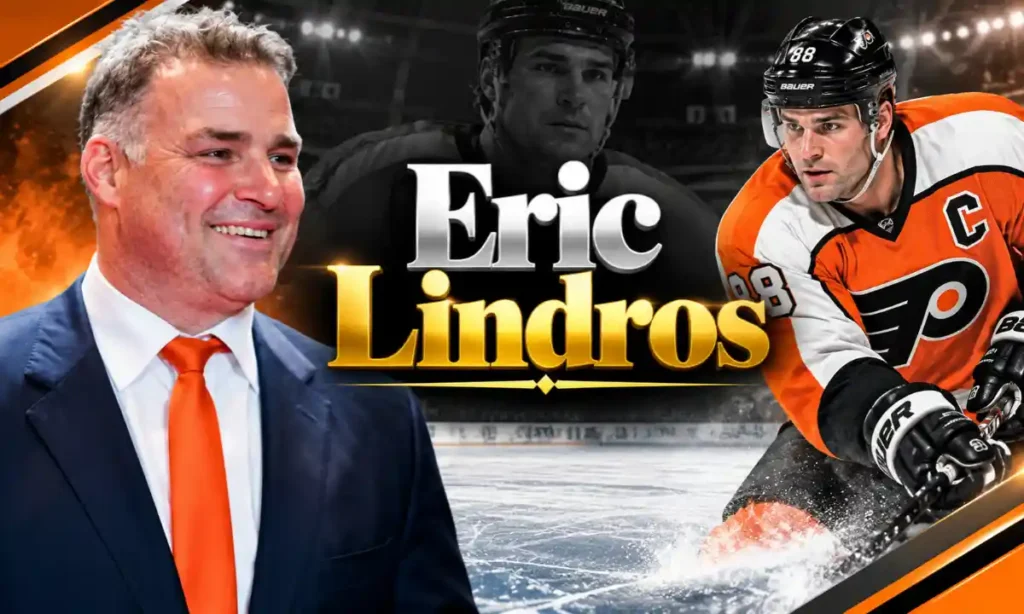
Eric Lindros stood 6 ft 4 in and weighed 240 lb, yet he moved with the agility of someone much smaller and lighter. This characteristic shaped much of his career. It led to a team trading half its roster and fifteen million dollars for him before he played an NHL game, contributed to his Hart Trophy win at age 22, and resulted in opponents deciding that the only way to stop him was by targeting his head.
He played 760 games and accumulated 865 points. Based on the rate at which he was scoring at his peak, an entire career would have ranked him among the very best scorers in the history of the game. Instead, he called it quits at 34 after his number of concussions had reached eight, and the debate about what he could have been has never gone away.
Here is everything: the numbers, the stand, the peak, the hits, the cash and where he is now.
Physical Stats
His size is not trivia on this page. It was the whole basis of how he played and how he was played against, so it belongs near the top.
| What People Ask | The Answer |
|---|---|
| How tall is Eric Lindros? | 6 ft 4 in (193 cm). |
| How much did he weigh? | 240 lb (approximately 109 kg) during his playing days. |
| Why do his measurements matter so much? | At his size, Lindros combined exceptional strength with impressive skating speed, making him difficult to move off the puck. |
| What position did he play? | Centre; he shot right. |
| What number did he wear? | Number 88, retired by both Oshawa and Philadelphia. |
| How old is Eric Lindros? | 53 years old. He was born on February 28, 1973. |
| Where is he from? | London, Ontario; he grew up largely in Toronto. |
| What were his nicknames? | “The Next One” and “The Big E.” |
| Which teams did he play for? | Philadelphia Flyers, New York Rangers, Toronto Maple Leafs, and Dallas Stars. |
| Is he in the Hall of Fame? | Yes, he was inducted into the Hockey Hall of Fame in 2016. |
| Does hockey run in the family? | Yes. His younger brother Brett played for the New York Islanders and retired at age 23 because of post-concussion syndrome. |
For scale, a 240 lb forward was almost like a giant when he turned up. Defenceman back then were often losing forty or fifty pounds to him and because he could skate he could carry the puck to the net and simply drive through whoever was there. No team had a solution to that. That is the context for the rest of the things you’ll see below about concussions.
The Trade That Took a Year and an Arbitrator
Lindros was drafted first overall in Quebec in 1991 and refused to sign. He’s always been clear why: it wasn’t the city, the province, the language or the culture; it was the club’s owner. He sat out, played for Canada, and waited.
A year later Quebec negotiated with two clubs simultaneously and settled with both Philadelphia and the New York Rangers. An arbitration panel decided that the Flyers had settled with Lindros about eighty minutes before the Rangers did. Lindros to Philadelphia.
What Quebec returned with is still the most any individual has ever returned with.
| What Quebec Received | Why It Mattered |
|---|---|
| Peter Forsberg (his playing rights) | The key piece of the trade, Forsberg became one of the best forwards of his generation and a Hockey Hall of Famer. |
| Ron Hextall | An established starting goaltender who added experience to the team. |
| Mike Ricci | A young centre who went on to become a long-serving NHL forward. |
| Steve Duchesne | An established, high-scoring defenceman already in his prime. |
| Kerry Huffman | A defenceman who provided additional depth as part of the deal. |
| Chris Simon | Added later by the arbitrator when the original trade package was adjusted. |
| First-round picks in 1992, 1993 and 1994 | Three additional swings at the draft on top of the players. |
| $15 million in cash | Enough money to matter a great deal to a struggling franchise. |
The judgment on that deal still evolved. Philadelphia received nine years from a player who was at his peak the most physically imposing forward in the game. Quebec received the core of a franchise that relocated to Colorado and claimed the Stanley Cup in less than four years, and a career that would ultimately be more enduring and more successful than the one they traded away in Forsberg.
The Peak
There was a stretch from 1992-2000 where I’d say Lindros was probably the best player in the world.
He finished the season with 41 goals as a rookie and 44 more the next. He collected 70 points in 46 games during the lockout-shortened 1994-95 season, won the Hart Trophy as most valuable to the writers, and the Lester B. Pearson Award as most valuable to the players (both voted on by his peers), in his 22-year-old sophomore season. He was on the First All-Star Team that season and on the Second All-Star Team the next.
He played centre on the Legion of Doom line with John LeClair and Mikael Renberg, three large forwards whose style was unmatched at the time, and served as Philadelphia’s captain from 1994 to 2000. In 1997, he led the Flyers to the Stanley Cup Final, where Detroit defeated them in a sweep. His 26 points in 19 games during that playoff run marked the best postseason performance of his career.
| Season | Team | Games | Goals | Assists | Points | What Was Happening |
|---|---|---|---|---|---|---|
| 1992–93 | Philadelphia | 61 | 41 | 34 | 75 | A 41-goal rookie season and a place on the All-Rookie Team. |
| 1993–94 | Philadelphia | 65 | 44 | 53 | 97 | Scored 44 goals in 65 games, a rate very few players have matched. |
| 1994–95 | Philadelphia | 46 | 29 | 41 | 70 | The Hart Trophy season, played during a schedule shortened by a lockout. |
| 1995–96 | Philadelphia | 73 | 47 | 68 | 115 | Reached his career high in points with the Legion of Doom at full power. |
| 1996–97 | Philadelphia | 52 | 32 | 47 | 79 | Faced regular-season injuries but recorded 26 points in 19 playoff games. |
| 1997–98 | Philadelphia | 63 | 30 | 41 | 71 | Concussions began affecting his career during this period. |
| 1998–99 | Philadelphia | 71 | 40 | 53 | 93 | Scored 40 goals again and suffered a collapsed lung. |
| 1999–00 | Philadelphia | 55 | 27 | 32 | 59 | The season ended with the hit that became one of the defining moments of his career. |
| 2000–01 | Did not play | 0 | 0 | 0 | 0 | A contract standoff with Philadelphia cost him the entire season. |
| 2001–02 | New York Rangers | 72 | 37 | 36 | 73 | Made a strong return to form in his first season in New York. |
| 2002–03 | New York Rangers | 81 | 19 | 34 | 53 | Played his only full 80-game campaign. |
| 2003–04 | New York Rangers | 39 | 10 | 22 | 32 | His season was cut short by another concussion. |
| 2005–06 | Toronto | 33 | 11 | 11 | 22 | A wrist ligament tear ended his season. |
| 2006–07 | Dallas | 49 | 5 | 21 | 26 | Played his final season at age 34. |
| Career | — | 760 | 372 | 493 | 865 | Thirteen seasons and 1,398 penalty minutes. |
Look at the games column rather than the points column. He passed 70 games in a season only four times in thirteen years. His rate of scoring, 865 points in 760 games, was better than a point a game across a career in which he was almost never fully fit.
The Concussions
They arrived in batches starting in 1998-2000, then continued to come. The first was a Darius Kasparaitis hit that cost him 18 games. A second soon followed, that same season. In April 1999, during a road trip, he had a collapsed lung due to internal bleeding, and a teammate demanded he go to hospital. His family said later the delay could have been fatal.
Then a shoulder check from Scott Stevens in Game 7 of the 2000 Eastern Conference Final knocked him out at centre ice. Philadelphia was up 3-1 in that series before losing. The hit was legal by the standards of the day and is still replayed in highlight packages, which is part of why hockey took so long to reckon with what it was watching.
The end of his career saw eight documented concussions. The fight with the Philadelphia administration over a particular diagnosis, that of one of those concussions, led to him being stripped of the captaincy in 2000 and the huge consequences from that were felt in the next year.
And then it gets worse because family is involved. His younger brother Brett, an Islanders first-round pick, also left the game at 23 because of post-concussion syndrome. Eric has become a vocal advocate for concussion-awareness legislation in Ontario and has been open about brain injury since leaving hockey.
Net Worth and Career Earnings
This is the section where most pages about him simply invent a number, so it is worth being careful.
| What You Want to Know | The Figure | What It Actually Tells You |
|---|---|---|
| What did he earn in the NHL? | $68,450,000 | A documented career total calculated from his published season-by-season salaries. |
| What is that worth in today’s money? | Around $138 million | Inflation significantly increases the equivalent value of salaries earned during the 1990s. |
| What was his best-paid season? | $8,500,000 | He was the highest-paid player in the league that year. |
| Where does he rank among all-time earners? | Around 147th in raw dollars | His ranking rises to approximately 51st when earnings are adjusted for inflation. |
| What is his net worth? | No reliable figure exists | Published estimates cluster around $30 million, but these figures are not officially verified. |
| How much did he give away? | $5 million | A donation to London Health Sciences Centre in his home city. |
The net worth estimates are suspect. The most often quoted figure puts him at 30 million dollars, but the page that carries it lists three different totals of his earnings over his career at three different points, any of which is different from the first, and none are consistent with the salary record. A site that can’t keep its own numbers straight can’t be trusted on the worth of a private citizen two decades after his last game.
The best answer is the answer this page has given. His income is known. His net worth is hidden, and even then, is made up of investments and tax returns that no one outside of his inner circle has access to, and any article quoting the figure to within a million is speculating.
International Hockey
Lindros won World Junior Championship gold with Canada twice and held the country’s all-time scoring record for that tournament, at 31 points, for more than three decades.
He earned Olympic silver in 1992 before he would sign with Quebec, competed again in 1998, and was a gold medalist in Salt Lake City in 2002. During the 1993 World Championship he was the leading scorer for Canada and was selected as the tournaments best forward.
Life After Hockey
He announced his retirement in his hometown of London Ontario at age 34. He gave five million dollars to London Health Sciences Centre, acted as an ombudsman for the players’ association for approximately 15 months, and has been involved in concussion activism ever since.
The Hockey Hall of Fame inducted him in 2016, a wait long enough that it became a story in itself. The NHL named him to its list of the 100 Greatest Players this year. Oshawa retired his number 88 in 2008 and Philadelphia did the same a decade later. He was appointed to the Order of Ontario in 2022.
Where to Find Him Online
We checked each platform rather than guessing, and the results are mixed, which is worth saying plainly.
| Platform | Where to Find Him | What We Found When We Checked |
|---|---|---|
| X (formerly Twitter) | @88EricLindros | Reported as active and personally managed. Major news outlets have covered Q&A sessions conducted through this account. |
| @88ericlindros | A profile exists under the same handle associated with his name on X. | |
| EricLindros88 | A page exists under his name using the same numbering convention. | |
| YouTube | No personal channel found | His Hall of Fame speech and career highlights are available through NHL, team, and broadcaster channels. |
| Nothing found | No public professional profile was identified. His speaking engagements are handled through agencies instead. |
The short version is that X is where he actually posts. He is not a prolific social media presence on any platform, and there is no official website or newsletter.
Questions People Ask
How tall is Eric Lindros?
6 ft 4 in, or 193 cm, and he played at 240 lb. He was one of the largest forwards in the league throughout his career.
How old is Eric Lindros?
He is 53, born on 28 February 1973 in London, Ontario.
What is Eric Lindros’s net worth?
No reliable figure exists. His documented NHL earnings came to 68,450,000 dollars, which is worth roughly 138 million in today’s money. Published net worth estimates of around 30 million are guesses, and the pages carrying them contradict their own career earnings numbers.
Why did Eric Lindros refuse to play for Quebec?
He has said consistently that his objection was to the club’s owner personally, and not to the city, the province, the language or the culture. He sat out a year rather than sign, and was traded to Philadelphia in 1992.
What did Quebec get for Eric Lindros?
Peter Forsberg’s playing rights, Ron Hextall, Mike Ricci, Steve Duchesne, Kerry Huffman, Chris Simon, first-round picks in 1992, 1993 and 1994, and fifteen million dollars.
How many concussions did Eric Lindros have?
Eight were recorded during his NHL career. The best known came in Game 7 of the 2000 Eastern Conference Final, on a shoulder check from Scott Stevens.
What are Eric Lindros’s career stats?
760 games, 372 goals, 493 assists and 865 points, with 1,398 penalty minutes. In the playoffs he had 57 points in 53 games.
Did Eric Lindros win a Stanley Cup?
No. He reached the Final once, with Philadelphia in 1997, and Detroit swept the series. He did win Olympic gold with Canada in 2002.
Is Eric Lindros in the Hall of Fame?
Yes. He was inducted into the Hockey Hall of Fame in 2016 and named to the NHL’s 100 Greatest Players list in 2017.
Also read about: Mario Lemieux: The Player Who Ended Up Owning the Team, and Has Now Walked Away From It

