
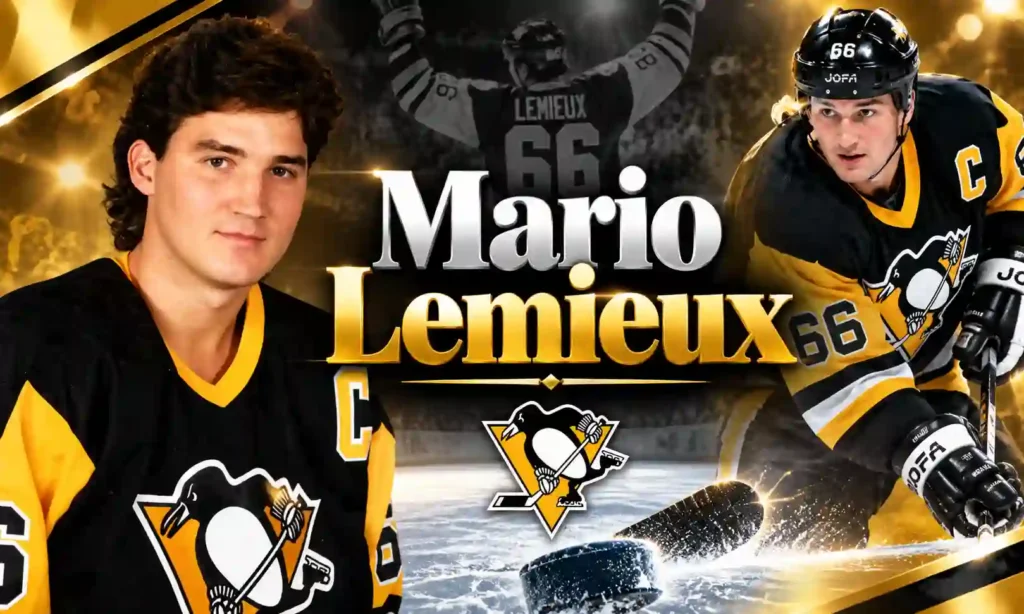
In August 2026, Mario Lemieux sold his final shares in the Pittsburgh Penguins. The transaction was small and received little national attention, but it marked the end of a rare 42-year association between one individual and a single franchise. This connection began when the Penguins drafted him in 1984 and included two Stanley Cups as a player, a bankruptcy, a rescue, a comeback, and three additional Stanley Cups as the owner who signed the checks.
No financial ties now. Not since he was 18 years old. What follows is the whole of it, in order: the player, the illness, the owner, and the numbers underneath all three.
The Short Version
If you only want the headline facts, they are here.
| What People Ask | The Answer |
|---|---|
| How old is Mario Lemieux? | He is 61 years old. He was born on 5 October 1965, in Montreal. |
| How tall was he? | He was 6 ft 4 in tall and played at around 230 lb. He was enormous for a centre of his era. |
| What position did he play? | Centre. |
| Which team did he play for? | Pittsburgh Penguins, throughout his 17-season NHL playing career. |
| Where was he drafted? | First overall in the 1984 NHL Draft. He scored on his very first NHL shift, with his first shot. |
| How many points did he score? | 1,723 points in 915 games, averaging approximately 1.88 points per game. |
| How many Stanley Cups did he win? | Five with the Penguins organization: two as a player and three as an owner. |
| What was his nickname? | Le Magnifique and, in Pittsburgh, Super Mario. |
| Why did he retire early the first time? | Back problems and the effects of radiation treatment for cancer. He was 31 when he first retired. |
| Did he really come back? | Yes. He returned to the NHL after more than three years away, while owning the Penguins. |
| Is he still involved with the Penguins? | No. He sold his remaining ownership shares in 2026, ending a connection that began in 1984. |
Five Cups, Two Different Jobs
The simplest way to understand how strange his career was is to lay out the championships, because he won them in two completely different capacities.
| Year | Capacity | Beaten in the Final | The Detail Worth Knowing |
|---|---|---|---|
| 1991 | Player | Minnesota North Stars | His first Stanley Cup. He won the Conn Smythe Trophy after leading all playoff scorers. He had returned from back surgery and an infection only months earlier. |
| 1992 | Player | Chicago Blackhawks | A sweep, a second consecutive Stanley Cup, and a second straight Conn Smythe Trophy. |
| 2009 | Owner | Detroit Red Wings | Ten years after he and Ron Burkle bought the Penguins out of bankruptcy. |
| 2016 | Owner | San Jose Sharks | The first of back-to-back championships, with a team featuring Sidney Crosby, built during his ownership. |
| 2017 | Owner | Nashville Predators | His fifth Stanley Cup with the Penguins organization, achieved across two completely different roles. |
The Player
Standing 6 ft 4 in and 230 lb in an era when that made him a giant among centres and carrying the puck like a guy half his size, he scored on his first NHL shift, on his first shot and ended his first season with 100 points and the Calder Trophy.
It was a peak: 85 goals, 114 assists, 199 points in 1988-89, missing 200 by a point, a feat only Gretzky has ever managed. On New Year’s Eve of that season he scored five different ways in a 5-for-5 performance in one game at even strength shorthanded on a penalty shot, into an empty net and on the power play, a feat no one else has ever achieved.
During his career he accumulated 1,723 points in 915 games. That’s 1.88 points a game, second only to Gretzky amongst players who played a long time, and he did that with a body that always seemed to be letting him down.
| Season | Games | Goals | Assists | Points | What Was Happening |
|---|---|---|---|---|---|
| 1984–85 | 73 | 43 | 57 | 100 | A 100-point rookie season and the Calder Trophy. |
| 1985–86 | 79 | 48 | 93 | 141 | His first truly enormous year. |
| 1986–87 | 63 | 54 | 53 | 107 | Missed time but still scored 54 goals. |
| 1987–88 | 77 | 70 | 98 | 168 | Won his first Art Ross Trophy and Hart Trophy. |
| 1988–89 | 76 | 85 | 114 | 199 | His career-best season, finishing just one point short of 200. |
| 1989–90 | 59 | 45 | 78 | 123 | A 46-game point streak ended because of a back injury. |
| 1990–91 | 26 | 19 | 26 | 45 | Back surgery and an infection cost him most of the season. He returned to win the Stanley Cup. |
| 1991–92 | 64 | 44 | 87 | 131 | Won another scoring title and his second Stanley Cup. |
| 1992–93 | 60 | 69 | 91 | 160 | Diagnosed with cancer in January, returned to the ice in March, and still won the scoring title. |
| 1993–94 | 22 | 17 | 20 | 37 | A second back operation in July left him with very little playing time. |
| 1994–95 | 0 | 0 | 0 | 0 | Sat out the entire season, exhausted by the after-effects of radiation treatment. |
| 1995–96 | 70 | 69 | 92 | 161 | Made a remarkable return, winning another Art Ross Trophy and Hart Trophy. |
| 1996–97 | 76 | 50 | 72 | 122 | Won his sixth scoring title before retiring at age 31. |
| 2000–01 | 43 | 35 | 41 | 76 | Returned after 44 months away, this time as the Penguins’ owner. |
| 2001–02 | 24 | 6 | 25 | 31 | Injuries limited his appearances, while he won Olympic gold with Canada. |
| 2002–03 | 67 | 28 | 63 | 91 | Played his last full NHL season. |
| 2003–04 | 10 | 1 | 8 | 9 | Played just ten games before another injury interrupted his season. |
| 2005–06 | 26 | 7 | 15 | 22 | An irregular heartbeat ultimately ended his playing career. |
| Career | 915 | 690 | 1,033 | 1,723 | Seventeen NHL seasons, all with the Pittsburgh Penguins. |
Looking down the games column, his career appears more interrupted than continuous. He never played a complete 80-game season, with his highest total being 79 games in 1985-86. Still, he reached 100 points or more in ten of his seventeen seasons.
January 1993
Lemieux was diagnosed with Hodgkin’s disease in January 1993. He was 27 years old and the league’s top scorer.
He underwent radiation through February. On 2 March, the day of his last treatment, he flew back to Philadelphia and played that night. He was 12 points behind Pat LaFontaine in the scoring race when he was forced to stop playing. He ended up 12 points ahead of LaFontaine. He won the Art Ross, the Hart, and the Masterton Trophy for perseverance that season. The Penguins won 17 straight games.
Finally, the price. A second back surgery in July wiped out his next season, then the fatigue from radiation kept him out the entire 1994-95 campaign, and when he retired in 1997, at 31, he said the pain was both physical and mental. Cancer research in Pittsburgh has been the beneficiary of his generosity ever since, through the foundation that bears his name.
The Owner
The Penguins, almost bankrupt when he announced his retirement, had more than 32 million in deferred salary owing to him. A club that cannot pay its debts cannot pay an ex- superstar.
“So he rearranged his debts into stock, teamed up with Ron Burkle and bought the team. The deal was approved in September 1999. It’s one of the strangest fixes to a sports insolvency anyone has ever concocted, and somehow it worked.”
| When | What Happened |
|---|---|
| 1997 | He retires as a player. The Penguins owe him more than $32 million in deferred salary and are heading towards bankruptcy. |
| September 1999 | He and Ron Burkle buy the club out of bankruptcy, with much of his deferred salary converted into equity. The player the team could not pay becomes the man who owns it. |
| December 2000 | He returns to play for the team he owns, 44 months after his last game. |
| 2009, 2016, 2017 | Three more Stanley Cups, this time from the owner’s box. |
| December 2021 | The Lemieux group sells the Penguins to Fenway Sports Group for a reported $900 million. He retains a minority stake and remains involved. |
| June 2026 | Fenway sells the club to the Hoffmann Family of Companies in a deal reported at approximately $1.7 billion. |
| August 2026 | He sells his remaining shares. For the first time since the Penguins drafted him in 1984, he has no financial stake in the franchise. |
The sequence in the middle of that table is often overlooked. In December 2000, fifteen months after purchasing the club, he resumed playing for it, putting his own skates back on. At age 35, after a 44-month absence from the game, he recorded 76 points in 43 games. Two years later, he captained Canada to Olympic gold in Salt Lake City, ending a drought that had lasted fifty years.
He finally hung it up in early 2006 when he was diagnosed with a heart condition. He remained owner another 15 years, through two more titles, until his sale to Fenway Sports Group in December 2021, then the outright sale of his shares last August.
The Trophy Case
Laid out with the years attached, since a surprising number of pages give the counts and skip the dates.
| Award | Years Won | What It Is For |
|---|---|---|
| Art Ross Trophy | 1988, 1989, 1992, 1993, 1996, 1997 | Awarded to the NHL’s leading scorer. Lemieux won it six times. |
| Hart Memorial Trophy | 1988, 1993, 1996 | Awarded to the league’s most valuable player, as voted by sportswriters. |
| Conn Smythe Trophy | 1991, 1992 | Awarded to the playoff MVP. Lemieux won it in consecutive Stanley Cup runs. |
| Ted Lindsay Award | 1986, 1988, 1993, 1996 | Awarded to the NHL’s most outstanding player, as voted by fellow players. It was known as the Lester B. Pearson Award during those years. |
| Calder Memorial Trophy | 1985 | Awarded to the NHL’s rookie of the year. |
| Bill Masterton Trophy | 1993 | Recognizes perseverance, sportsmanship, and dedication to hockey. Lemieux received it after returning from cancer treatment. |
| First All-Star Team | 1988, 1989, 1993, 1996, 1997 | Recognized as one of the league’s best players at his position, with four additional Second All-Star Team selections. |
| Hockey Hall of Fame | Inducted in 1997 | Lemieux was inducted in the same year he retired, waiving the usual three-year waiting period. |
Canada
His international record is shorter than his NHL one but it contains two of the most significant moments in Canadian hockey. He scored 11 goals in nine games at the 1987 Canada Cup, including the winner in the final. He captained the team that won Olympic gold at the 2002 games in Salt Lake City, Canada’s first Olympic men’s gold in 50 years. Along the way he earned World Cup gold in 2004, a World Championship silver medal in 1985 and a World Junior bronze in 1983, earning induction into the IIHF Hall of Fame in 2008.
Questions People Ask
How many Stanley Cups did Mario Lemieux win?
Five with the Penguins. Two as a player, in 1991 and 1992, and three as the club’s owner, in 2009, 2016 and 2017.
How many points did Mario Lemieux score?
1,723 in 915 regular season games, made up of 690 goals and 1,033 assists. In the playoffs he had 172 points in 107 games.
What was Mario Lemieux’s best season?
1988-89, when he scored 85 goals and 114 assists for 199 points, one short of 200.
Did Mario Lemieux have cancer?
Yes. He was diagnosed with Hodgkin’s lymphoma in January 1993, had radiation treatment, and returned to play on 2 March, the day of his final session. He won the scoring title that season after returning.
Why did Mario Lemieux retire twice?
He retired in 1997 at 31 because of chronic back problems and the after-effects of radiation treatment. He returned in December 2000 and retired for good in early 2006 after being diagnosed with an irregular heartbeat.
Did Mario Lemieux own the Penguins?
Yes, from 1999 until 2021. He and Ron Burkle bought the club out of bankruptcy, with much of the deferred salary the team owed him converted into equity. He kept a minority stake after selling to Fenway Sports Group and sold his final shares in August 2026.
How old is Mario Lemieux?
He is 61, born on 5 October 1965 in Montreal.
Is Mario Lemieux better than Wayne Gretzky?
Gretzky scored more and stayed healthy. Lemieux scored at 1.88 points a game to Gretzky’s higher rate, across a career repeatedly broken by back surgery and cancer treatment. It is an argument without an answer, which is why people still have it.
Also read about: Jason Robertson and the Twelve Million Dollar Question Dallas Has Not Answered

