
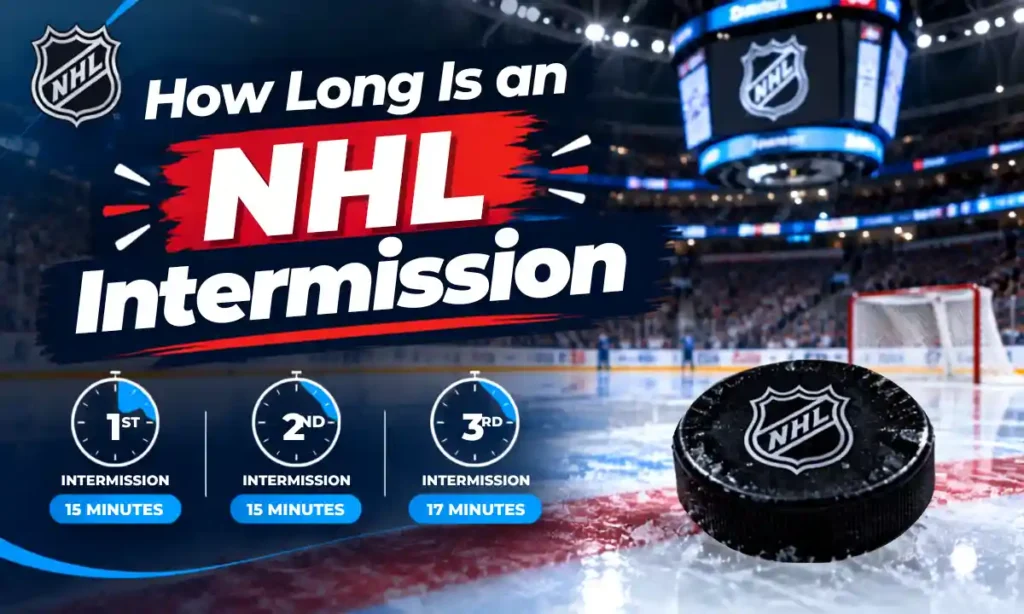
NHL intermission time is 18 minutes. They happen twice per match – after the first and second periods – hence the total intermission time is 36 minutes. The provision is stated in rule 34.2 of the NHL rule book and is applicable to both league and playoff matches. There are some notable exceptions. In between each of the playoff overtime periods, the intermission time is 15 minutes. Prior to regular season overtime match, no intermission occurs but only a break of about two minutes and no intermission prior to shootout.
NHL Intermission Times at a Glance:
Every break in an NHL game, with the rulebook figures.
| Standard NHL intermission | 18 minutes |
|---|---|
| Rulebook reference | NHL Rule 34.2 |
| When they occur | After the first period and after the second period |
| Intermissions per game | 2, totalling 36 minutes |
| Playoff intermissions | Also 18 minutes after the first and second periods. The format does not change |
| Between playoff overtime periods | 15 minutes, with a full ice resurfacing |
| Before regular-season overtime | No full intermission. A short break of roughly two minutes |
| Before a shootout | No intermission |
| What happens during one | Ice resurfacing, usually by two machines, then crews clear standing water and let the surface set. Players rest and coaches adjust |
| Typical regular-season game length | About 2 hours 20 minutes to 2 hours 45 minutes in real time |
| Regulation playing time | 60 minutes, in three 20-minute periods |
| Common wrong answers online | 15 minutes, 15 minutes 30 seconds and 17 minutes. All are outdated |
| NCAA hockey | Typically around 15 minutes |
| Youth and high school | Shorter, commonly in the region of 10 to 15 minutes, varying by league |
| Longest game in NHL history | Detroit and the Montreal Maroons on 24 March 1936, which reached a sixth overtime period |
Why You Will See 15 and 17 Minutes Online:
This search yields an unusually high number of conflicting answers, so I will explain how the numbers are wrong. When searching for NHL intermission time, you can find 15 minutes, 15 minutes and 30 seconds, 17 minutes and 18 minutes as answers, all stated with equal certainty. Some of these pages are very old and have never been updated, some of them are based on them.
The intermission time used to be shorter, that is why 15 and 17 minutes can be found in old literature and memory of older people. In modern rules the time is 18 minutes. When another number is stated and not referenced to the rule, it is based on an old number. Also, one interesting thing about old answers is the statement that games nationally broadcast have longer intermissions. In reality, 18 minutes is standard for everyone, even nationally broadcasted games. Advertisements fit into the 18 minutes.
What Actually Happens in 18 Minutes:
It is not an arbitrary division of time either – it revolves around the duration necessary to prepare the ice for play. Two resurfacing machines are generally used on the surface where a thin layer of water is spread over the scraped ice. This water needs some time to set, while the surface is dried up in order to avoid having players skate on ice which has not yet set, as this is bad quality and increases the chances of injuries.
All the remaining time is used for many things at once – the players have a chance to rest in the locker room, change equipment and hydrate, the coaching staff analyzes the period and adjusts the line-ups and tactics, while the broadcasters do the same with the commercials and analysis. Eighteen minutes is a compromise solution which suits everyone, but it is the ice preparations which define the base.
Playoff Overtime Intermissions:
Here, is when the format really changes, and also, here lies much of the confusion. Overtime periods during the playoffs involve full 20-minute sudden death sessions at five-on-five, played continuously until someone scores. Between these overtime periods, there is a 15-minute break where the entire surface of the ice is resurfaced.
For the intermissions between the first two periods of the playoff match, there is still 18 minutes, same as in the regular season. It is only the intermission periods for the overtimes which are shorter. Sites that claim that the intermission periods during playoffs are 15 minutes use the overtime period rules for the entire game.
The total time difference becomes quite significant when the game gets long. The record in the NHL involves a game between Detroit and Montreal Maroons on 24 March 1936, which involved six overtime periods. This means five intermissions between the overtimes, together with the two regular intermissions, totaling more than an hour and a half of empty ice.
Regular-Season Overtime and Shootouts:
There is no complete intermission during the extra time for the regular season. If there is a tie during the 60 minutes of the game, both teams will have a short break of about two minutes and then start playing a three-on-three game for five minutes. In case this doesn’t solve anything, then a shootout starts without any additional pause. Everything should be fast – this is totally the opposite to the playoffs.
How Intermissions Fit Into Total Game Time:
An NHL game in regulation consists of 60 minutes of playing time divided into three periods of 20 minutes each, but in reality, a hockey game takes much longer due to frequent stoppages of the clock during whistles, goals, penalties, and TV timeouts.
A game which ends in regulation during the regular season takes about two hours and 20 to 35 minutes. In case of overtime, it will be around two hours and 40 to 50 minutes, while a game with a shootout may take up to two hours and 45 minutes. During all that time, there are 36 minutes of intermission. However, it is difficult to predict the length of an overtime game in playoffs.
Intermissions at Other Levels:
The 18-minute figure is specific to the NHL. Other levels run shorter breaks, largely because they do not carry the same broadcast requirements.
- AHL and ECHL: Broadly follow NHL standards, though non-televised games may run slightly shorter.
- NCAA hockey: Typically around 15 minutes.
- Junior, high school and youth hockey: Shorter again, commonly somewhere between 10 and 15 minutes depending on the league and the rink’s resurfacing arrangements.
- International tournaments: Vary by competition and broadcaster.
If you are checking a time for a specific league, use that league’s own rulebook rather than assuming the NHL figure applies.
Final Take:
NHL intermissions last for 18 minutes, twice per game, according to Rule 34.2. The overtime intermissions for playoffs last 15 minutes. In regular seasons, there is a brief intermission of around two minutes for overtime play; no intermission at all for shootouts. For timing your food run, 18 minutes is your limit, and that will be the same whether it is April or October.
SEO and Editorial Notes for the Team:
1. CITE THE RULE. The single strongest thing on this page is naming Rule 34.2. The competing pages state 15, 15:30, 17 or 18 minutes with no source, and several contradict each other within the same article. Citing the rulebook is what makes this the answer rather than another opinion.
2. The correction section is the differentiator. Do not remove it. People arriving at this query have often already seen a different number and want to know which is right. Explaining that older figures come from earlier eras resolves that in a way a bare 18 does not.
3. The playoff distinction is the most common error in the category. 18 minutes after periods one and two, 15 minutes between overtime periods. Several ranking pages have applied the overtime figure to the whole playoff game. Keep the two clearly separated.
4. The nationally televised games get longer intermissions claim appears in older sources and is not in the rulebook. We have flagged it as incorrect rather than repeating it.
5. This is a stable evergreen page with no seasonal spike and almost no staleness risk, unlike the oldest player page. Review annually against the current rulebook and otherwise leave it alone.
6. Internal links: NHL season length, playoff format, and any how long is a hockey game content. This sits naturally in the basics cluster and answers a question that feeds directly into the game length query.
Frequently Asked Questions:
How long is an NHL intermission?
18 minutes, after the first period and after the second. NHL Rule 34.2 sets the figure, and it applies in both the regular season and the playoffs.
How many intermissions are in an NHL game?
Two, totalling 36 minutes. There is no break between the end of the game and any shootout.
How long is the intermission before playoff overtime?
15 minutes, with a full ice resurfacing, and the same again between each subsequent overtime period.
Is there an intermission before regular-season overtime?
No full intermission. Teams get a short break of roughly two minutes before the five-minute three-on-three period begins.
Why do some websites say NHL intermissions are 15 or 17 minutes?
Because intermissions were shorter in earlier eras and many pages were never updated. The current rulebook specifies 18 minutes.
Are playoff intermissions longer than regular-season ones?
No. They are the same 18 minutes after the first and second periods. Only the breaks between overtime periods differ, at 15 minutes.
Why are NHL intermissions so long?
Mainly ice resurfacing. The surface has to be scraped, re-watered and then given time to set before skaters return. Player rest, coaching adjustments and broadcast advertising all fit inside that window.
How long is a hockey intermission in college?
NCAA hockey intermissions are typically around 15 minutes, shorter than the NHL’s 18.
How long is a full NHL game in real time?
Usually two hours 20 minutes to two hours 45 minutes for a regular-season game, of which 36 minutes is intermission. Playoff games with multiple overtimes can exceed four hours.
Also read about: When Does NHL Free Agency Start? 1 July at Noon Eastern

