
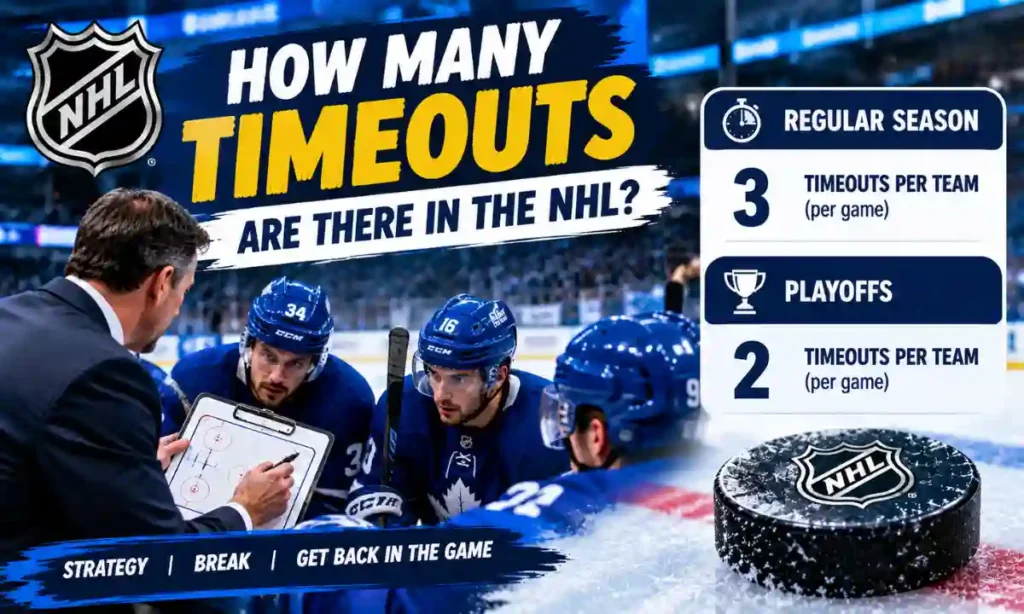
Each NHL team is given one time-out in each game which lasts for 30 seconds. This is all that is allowed under Rule 87, whether during the regular season or in the playoffs. The time-out must be taken during an ordinary stoppage of play, and if it is not used during the game proper, it may be used in the overtime period. The frequent asking of this question is due to the fact that there are many stoppages on NHL broadcasts which seem to be time-outs but actually aren’t. These are known as TV time-outs, and are distinct from the team’s time-outs.
NHL Timeout Rules at a Glance:
Team timeouts, TV timeouts and how other leagues compare.
| Timeouts per team | One per game |
|---|---|
| Length | 30 seconds |
| Rulebook reference | NHL Rule 87 |
| Applies to | Regular season and playoffs alike |
| When it can be called | Only during a normal stoppage of play, never while play is live |
| Who can call it | Any player on the ice, though in practice the bench signals it |
| Carries into overtime | Yes. An unused timeout remains available |
| Shootouts | No timeouts |
| After icing | A team that ices the puck cannot call its timeout |
| Coach’s challenge | No longer costs a timeout. A failed challenge brings a minor penalty for delay of game instead |
| TV timeouts | Three per period, two minutes each. Separate from team timeouts |
| TV timeout triggers | The first stoppage after the 14, 10 and 6 minute marks of each period |
| When TV timeouts are skipped | During a power play, immediately after a goal, and after icing |
| NCAA hockey | One timeout of 60 seconds in regulation, plus an additional one for overtime |
| IIHF and Olympic hockey | One 30-second timeout per team, and no TV timeouts |
| For comparison, NBA | Seven timeouts per team per game |
| For comparison, NFL | Three per team per half, six in total |
| NHL ranking | The fewest team timeouts of any major North American professional league |
How the Team Timeout Works:
One per team, per game, for a period of 30 seconds. There is no additional timeout allocated to the second half, or to the overtime situation, nor can it be carried over to subsequent games. It is only possible to take it during a regular stoppage of play. A team does not have an opportunity to call it during the game when the puck is still alive, which is a very important difference from basketball, where a player with the ball can always make a timeout.
Any player is technically allowed to make such a request, but, in reality, it is done from the bench. The 30 seconds period is used by the players to go to the bench and receive directions from the coach.
When You Cannot Use It:
- After your own team ices the puck. This closes an obvious loophole. Icing already forces the offending team to keep its tired players on the ice for the next faceoff, and allowing a timeout there would hand back the rest that the rule is designed to deny.
- Immediately after a TV timeout. Both benches have just had two minutes to rest and talk, so a further stoppage is not permitted.
- During a shootout. No timeouts are available once a game reaches the shootout.
TV Timeouts Are Not Team Timeouts:
This is the point that leads to most of the misunderstandings, and that is the reason why there are so many pauses in a hockey match as compared to the once-only rule. There are three breaks for commercial purposes in each period of two minutes each. The breaks are activated by the first whistle after the 14th, 10th and 6th minute marks. If the play continues uninterrupted beyond one of these minute marks, then the break takes place with the next pause in play. The breaks are missed in certain conditions such as during a power play, immediately after a goal and after an icing call. During these periods the advertisements are shortened as opposed to taking two minutes.
In case of a TV timeout, the ice crew clears any snow on the ice surface while the players take a breather at the bench and the coaches take advantage of the timeout as though it was theirs. This is exactly the reason why teams hardly ever require using their one timeout opportunity since there are already six two-minute breaks in each regulation period.
The Coach’s Challenge Rule Changed:
There is a great amount of literature which is inaccurate regarding this issue; thus, there is some need to make sure that it is explained correctly. In the original coach’s challenge system, it was necessary to possess a team’s timeout before issuing the challenge for a goalie interference or offside, and if the challenge was unsuccessful, then it would mean losing that timeout. The coaches very soon understood that a timeout is not something important in hockey, and they began challenging almost any call, losing their timeouts.
As a consequence, the rule was modified. If a challenge does not become successful, then a delay of game minor penalty occurs and not the loss of a timeout; and there is no need to have a timeout to use the challenge. The number of challenges decreased significantly when it became clear that losing a two-minute penalty for an incorrect challenge was not desirable. If you see a statement that in the NHL a team loses its timeout due to a failed challenge, this means that this information was written many years ago.
Why Hockey Has So Few Timeouts:
The number per team is the least amongst all major professional sports of North America. In the NBA, seven per game per team are allowed. In the NFL, three per half, and six for a whole game are allowed. In hockey, one is allowed per team.
The reason is because of the structure of the game. In hockey, substitutes occur spontaneously, where the change happens every 40 to 60 seconds in the game, and hence fatigue is continuously dealt with rather than through halts. The coach of a basketball or football game requires timeouts for resting and reorganising. The coach of a hockey game reorganises after every shift. There are numerous opportunities for talking in between the halts occurring automatically in the game.
When Coaches Actually Use It:
Since there is only one available, timing becomes key, and coaches will always reserve it for particular instances. The most frequent instance would be late in the game when it’s very close to the end of the game or right before the game when the coach wishes to establish a particular play from a faceoff. Another instance is more restorative since it allows players some time for recuperation if the team had to remain on the ice for a particular period due to an icing against them, but only if it wasn’t them who iced the puck. A third, but a less tactical use is interrupting the opponent’s momentum, which coaches in hockey rarely do compared to those in basketball since coaches have only one chance.
Timeouts at Other Levels:
This rule of the NHL is not applicable everywhere. In college hockey of the NCAA, each team is allotted one minute of time-out, plus an additional time out in overtime. This makes up twice the amount that NHL allows in a match which goes into overtime. As per IIHF rules, implemented in the Olympics and world championship matches, each team is allowed one 30 seconds time-out, and there are no time-outs on television at all. This is a major difference that makes an Olympic match last about two hours, whereas an NHL game lasts two and a half hours.
Final Take:
30-second timeouts for each team once per game, in normal pauses only, extendable into OT if unused, but not available after an icing call or in a shootout. And everything else that appears to be a timeout during a broadcast is a two-minute commercial break, which happens three times per period. If you’re coming from watching basketball or football to watching hockey, then this is the difference for you to know. The coaches are not saving their timeouts because they have none.
Frequently Asked Questions:
How many timeouts do NHL teams get?
One per team per game, lasting 30 seconds, under Rule 87. The same allowance applies in the regular season and the playoffs.
How long is an NHL timeout?
30 seconds. TV timeouts, which are separate, last two minutes.
Can NHL teams use their timeout in overtime?
Yes, if it has not already been used. It carries over from regulation. There are no timeouts in a shootout.
How many TV timeouts are in an NHL game?
Three per period, so six in a regulation game, each lasting two minutes. They are triggered by the first stoppage after the 14, 10 and 6 minute marks, and are skipped during a power play, immediately after a goal, or after icing.
Does a failed coach’s challenge cost a timeout?
No, not any more. A failed challenge brings a minor penalty for delay of game instead, and teams do not need to hold a timeout in order to challenge.
Can a team call a timeout after icing the puck?
No. The team that ices the puck cannot call its timeout, because that would return the rest the icing rule is designed to deny them.
Why does the NHL have only one timeout?
Hockey substitutes on the fly, so fatigue is managed shift by shift rather than through stoppages. The game also has six two-minute commercial breaks per regulation and two 18-minute intermissions, which gives coaches plenty of opportunity to talk.
How many timeouts are there in college hockey?
One per team in regulation, lasting a full minute, plus an additional timeout for overtime.
Also read about: How Do NHL Points Work? Both Kinds, Explained

