
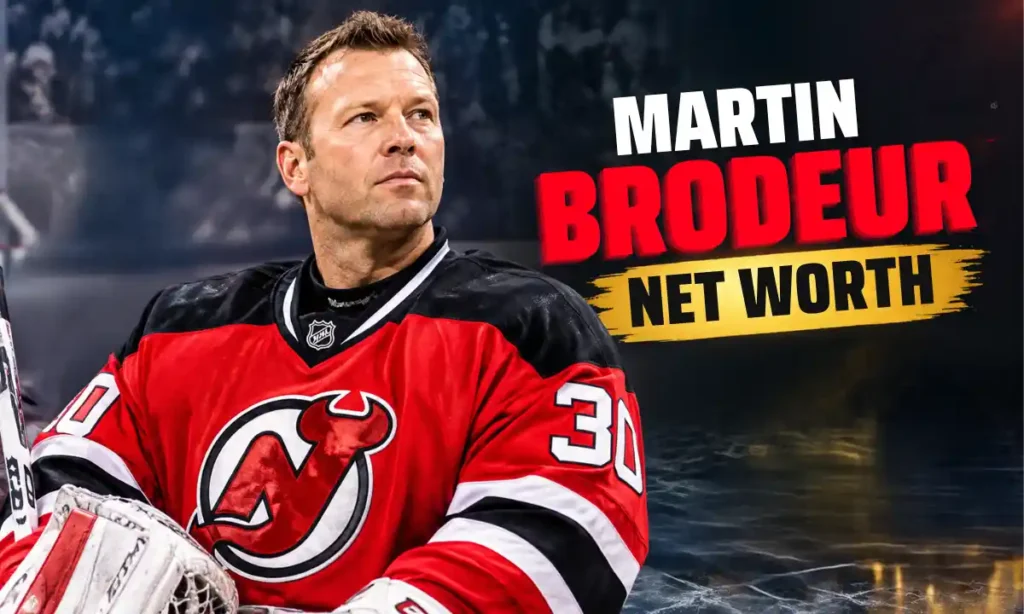
Martin Brodeur earned 81 598 224 dollars (sourced from his biography and the NHLPA). Converted to today’s cash, that is about 133.7 million dollars, which ranks him 42nd out of all NHL players ever. His wealth is an entirely separate matter, and the honest reply is that nobody outside of his own advisors really knows it. You can find the figure of 55 million dollars on every single celebrity finances website, it actually originates from a single estimate that dates back to around 2017 and has been replicated ad nauseum. Here’s what’s actually documented.
Martin Brodeur at a Glance:
Checked September 2026.
| Detail | |
|---|---|
| Net worth | No verified figure. The 55 million dollar number circulating everywhere traces to a single estimate from around 2017 |
| Career NHL earnings | 81,598,224 dollars, compiled from NHLPA figures and his own biography |
| In today’s money | Roughly 133.7 million dollars |
| Career earnings rank | 65th among NHL players. 42nd once adjusted for inflation |
| Biggest contract | Five years and 40 million dollars, signed in 2002. He negotiated it himself |
| Current role | Executive Vice President, Hockey Operations, New Jersey Devils |
| Age | 54. Born 6 May 1972 in Montreal |
| Drafted | 20th overall by New Jersey in 1990 |
| Playing career | 1991 to 2015, 21 seasons with the Devils and a final spell in St. Louis |
| Stanley Cups | Three, in 1995, 2000 and 2003 |
| Regular season records | 691 wins, 125 shutouts and 1,266 games, all NHL records |
| Playoff record | 113-91 in 205 games, a 2.02 goals-against average, a .919 save percentage and 24 shutouts |
| Hall of Fame | Inducted 2018 |
| Checked | September 2026 |
The 55 Million Dollar Figure, and Where It Came From:
Search this question and you will get the same number repeatedly. At least four separate sites give Martin Brodeur’s net worth as 55 million dollars, which looks like corroboration until you check the dates.
What the published figures actually show.
| Source type | Figure | What to know |
|---|---|---|
| Celebrity net worth sites | 55 million | The same figure appears across at least four sites, which means they are copying one another |
| Original estimate date | Around 2017 | One of those pages still carries a mid-2017 date next to the figure |
| Presented as | Current | Another displays a 2026 update date beside the identical 2017 number |
| Documented career earnings | 81.6 million | Compiled from NHLPA records and his biography, with sources listed season by season |
| What is missing | Everything else | Tax across two countries, investments, property, his executive salary since 2018, and endorsements |
One page of the bunch simply says the 2017 mid-year estimate. Another gives a 2026 revision date underneath the same figure. Yet another has no date at all. When four sites get the same figure down to the exact million, they’re not cross-checking each other, they’re all copying the same source.
That valuation also excludes eight additional years of income after his playing career. Brodeur has been a senior executive with New Jersey Devils since 2018, and none of this is captured in a valuation from 2017. So the 55 million figure isn’t a lie. It’s just old, unfashionable, and unsigned, and written as if it were current when it’s actually a nine year old estimate.
What He Actually Earned:
Contract earnings are a different category entirely, because they are filed and reported rather than estimated.
Every significant NHL contract of his career, in US dollars.
| Period | Term | Value | Detail |
|---|---|---|---|
| 1995 to 1997 | 3 years | 5,300,000 | His first significant deal, at roughly 1.77 million a season |
| 1998 to 2001 | 4 years | 15,200,000 | 3.8 million a season, as he became the league’s best goaltender |
| 2002 to 2006 | 5 years | 40,000,000 | 8 million a season, the largest of his career. He negotiated it without an agent |
| 2006 to 2011 | 6 years | 31,200,000 | 5.2 million a season, signed under the new salary cap system |
| 2012 to 2013 | 2 years | 9,000,000 | 4.5 million a season, his final Devils contract |
| 2014-15 | 1 year | 760,000 | A final season with St. Louis, close to the league minimum |
The 2002 contract is the one to stop on. That’s a lot of money for a goaltender, five years and 40 million dollars. Brodeur negotiated it himself; he didn’t even use an agent.0 Few players at that level have ever done that.
Why the Contracts Add Up to More Than He Earned:
Add every deal above together and you get 101.46 million dollars. The documented earnings figure is 81.6 million. That is a gap of roughly 20 million, and the reason is worth understanding because almost every net worth page confuses the two.
Contract value against actual earnings.
| Amount, US dollars | Detail | |
|---|---|---|
| Total contract value signed | 101.46 million | The sum of every deal he put his name to |
| Actually earned | 81.6 million | What he was paid. The gap is roughly 20 million dollars |
| 2004-05 season | Zero | The entire season was cancelled by a lockout, in the middle of his 8 million a year contract |
| 2012-13 season | Partial | A lockout cut the season to 48 games, and salaries were paid pro rata |
| The lesson | Contract value and career earnings are different numbers. Most pages confuse them |
The 2004-05 season was cancelled completely as a lockout occurred. Brodeur was in the middle of his 40 million dollar contract with an 8 million dollar a year salary and the season was just not played. Brodeur was not paid. The 2012-13lockout paid a pro-rated salary for a 48 game season.
This is the most frequent mistake found on athlete net worth pages. A website totals announced contract values, labels the total career earnings, and ignores lockouts, buyouts, escrow, or trades. For a player whose career crossed two work stoppages, the correction is twenty million dollars.
Inflation, and the Number Nobody Quotes:
There is a second adjustment that really makes an HUGE difference, yet nobody seems to use it. Brodeur’s work-best came from 1995 to 2011. Converted to today’s dollars, his 81.6 million becomes about 133.7 million. That’s moved him from 65 th on the all time earnings list for the NHL to 42 nd.
This is the best comparison to make him with the players of today. Nathan MacKinnon has already collected over a hundred and one million dollars and Cale Makar is going to walk through over two hundred and nineteen million in his career; but those are dollar figures from the 2020s and Brodeur’s are from the 1990s and 2000s. When properly adjusted, the difference exists but it is greatly smaller than the raw numbers indicate.
What He Does Now:
Brodeur is the Executive Vice President of Hockey Operations for the New Jersey Devils, a position awarded to him at the same time as a multi-year contract extension. The remit is full. It involves everything from personnel movements and managing the roster to transactions, scouting, and signing players, and he still has charge of the club’s Goaltending Development Department, which he founded and remains rather uncommon among NHL clubs.
The route there also wasn’t straight. After ending his playing career in 2015, he then joined the St. Louis front office. Upon his time back in New Jersey in 2018 as Executive Vice President of Business Development, he then spent time as an adviser to then general manager Tom Fitzgerald before fully moving on to the hockey aspect. He founded the MB30 Charity Golf Invitational, which helps generate money for the Devils Youth Foundation. He has not disclosed his executive compensation, which would be required for any other front office position in the league.
The Records Behind the Money:
The information about earnings makes more sense considering he had done for them. Brodeur’s regular season totals for wins 691 shutouts, 125 and games played 1 266, are all the most in NHL history by significant amounts. In the playoffs he went 113-91 in 205 games with a 2.02 goals-against average,.919 save percentage and 24 shutouts again the most in league history.
He won three Stanley Cups with New Jersey in 1995, 2000 and 2003, four Vezina Trophies, the Calder Trophy in 1994 and two Olympic gold medals with Canada and was inducted into the Hockey Hall of Fame in 2018 Furthermore he is the only goaltender to have a rule written on his behalf. The trapezoid behind the net, which was introduced in 2005 and is still commonly known as the Brodeur Rule, was put into effect because one goaltender was handling the puck a little too well.
Final Take:
Martin Brodeur made 81.6 million dollars while playing hockey, circa 133.7 million as of today, and has been collecting an unknown executive salary from the devils since 2018. His net worth is not known and the 55 million everywhere online is an estimate from 2017 with a “today’s date” The ‘useful’ number is the inflation adjusted one. It is the only way to compare a goaltender in the 1990’s dollar now to the players earning 20 million a season today.
Frequently Asked Questions:
What is Martin Brodeur’s net worth?
No verified figure exists. The 55 million dollars quoted across celebrity finance sites traces to a single estimate from around 2017 and does not account for his executive income since 2018. His documented NHL career earnings are 81,598,224 dollars.
How much did Martin Brodeur earn in his career?
81,598,224 dollars across his NHL playing career, which is roughly 133.7 million in today’s money. That ranks 65th among NHL players, or 42nd adjusted for inflation.
What was Martin Brodeur’s biggest contract?
Five years and 40 million dollars, signed in 2002, worth 8 million a season. He negotiated it himself without an agent.
Why is his career earnings figure lower than his contracts add up to?
Because of lockouts. The 2004-05 season was cancelled entirely while he was earning 8 million a year, and the 2012-13 season was cut to 48 games with salaries paid pro rata. Contract value and money actually received are different things.
What does Martin Brodeur do now?
He is Executive Vice President of Hockey Operations with the New Jersey Devils, covering personnel, roster management, transactions, recruitment and scouting, and overseeing the club’s Goaltending Development Department.
How old is Martin Brodeur?
54. He was born on 6 May 1972 in Montreal.
What records does Martin Brodeur hold?
Most regular season wins with 691, most shutouts with 125, most games played with 1,266, and most playoff shutouts with 24.
What is the Brodeur Rule?
The trapezoid behind the net, introduced in 2005, which restricts where a goaltender may play the puck. It was brought in because Brodeur was so effective at it.
Also read about: Nathan MacKinnon Net Worth: The Documented Numbers, Not a Guess

